This dictionary is a revised and expanded version of the
Bontok-English
Dictionary, with English Bontok Finder List (Pacific Linguistics, Series
C, No. 36, pp. 505, Canberra: Australian National University) that was
published in 1976, but which is now out-of-print and out-of-date. It is
also a completely reorganized and reprogrammed version of an earlier
on-line
Talking Dictionary of Bontok (1999) prepared under the
auspices of the Research Institute for Languages and Cultures of Asia
and Africa, Tokyo University of Foreign Studies.
Bontok (sometimes also spelled "Bontoc") is the name given to the group
of closely related languages which are spoken in the communities of
Bontoc, the capital of Mountain Province, one of the provinces of the
Cordillera Administrative Region of northern Luzon in the Philippines (
http://www.dilg.gov.ph/CAR/about_car_mt.htm).
Bontoc municipality is politically divided into sixteen politically
distinct administrative units or
barangay, most of which are
constituted of geographically distinct villages, each characterized by
its own dialect, having distinctive intonation, pronunciation and
lexical items. There are also a number of grammatical differences that
distinguish even geographically close communities. Many of the dialects
are, however, mutually intelligible, with the degree of intelligibility
greatest between communities that are geographically close, and less
between more distant communities. Together they form a chain of five
dialect groups, as shown in Figure 1.

This is a dictionary of one of the Central Bontok communities,
Guina-ang, a village of over 500 households, situated about 15
kilometers north of the town of Bontoc. Guina-ang people refer to their
language as
Khinina-ang, or simply
kalimi 'our language'.
Equivalent words from eleven of the other barangays of Bontoc
municipality will be included as information becomes available and can
be entered into the database. These communities are Bontoc Ili, Samoki,
Dalican, Ma-init, Maligcong, and Tocucan (which, together with
Guina-ang, constitute the Central Bontok dialects); Alab and Balili (two
of the South-western Bontok dialects); and Can-eo, Talubin, and Bayyo
(the Southern Bontok dialects).
The Bontok language group extends beyond the Bontoc municipality
northeast to include the dialects spoken in the Sadanga municipality, or
Northern Bontok. To the southeast, it includes the dialects spoken in
the Barlig municipality, or Eastern Bontok (also referred to in the
literature as Finallig). To the west, it merges into the Kankanay
language of the Sagada and Besao municipalities, and to the southwest
into the Kankanaey language of the Sabangan, Bauko and Tadian
municipalities and Benguet Province. It merges to the east into the
Balangao language of Natunin municipality, to the south into the
languages of Ifugao Province, and to the north into the languages of
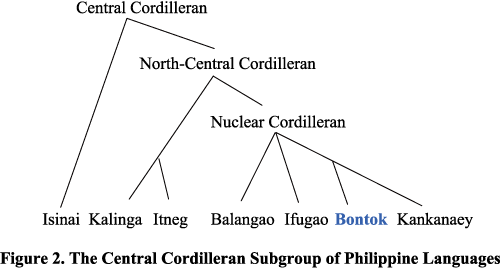
Kalinga Province. These languages form part of the Central Cordilleran
subgroup of Northern Luzon languages, as shown in Figure 2 and described
in Reid (
1974a).
This dictionary grew out of a wordlist gathered by the compiler during
his first visit to Guina-ang in August, 1959. Subsequently, through
extended periods of residence in Guina-ang until 1970 under the auspices
of the Summer Institute of Linguistics, Philippines, and in brief annual
visits thereafter during the compiler's association with the University
of Hawai`i, that wordlist was expanded until it reached its present
form.
In recent years, there has been increasing concern raised over the
status of minority and under-documented languages, such as
Khinina-ang,
because of the globalization of English, the pressure of national
languages and other factors, to the extent that many languages are no
longer being used or fall into the category of seriously endangered.
Khinina-ang
is one such language. Over the last half century, a wide variety of
factors has impacted the indigenous cultures of the Philippines,
resulting in a process of cultural homogenization, so that today much of
the once distinctive character of these communities has been modified
and is in serious danger of being lost. Probably nowhere in the
Philippines is this headlong rush to modernization and homogeneity more
apparent than in the once conservative areas of the mountain provinces
of the Northern Philippines. On the surface, the changes can be easily
seen in the shift of housing styles from the traditional thatched-roof
to the modern, wood-frame, lowland style with galvanized iron sides and
roof. Similarly, loss of traditional artifacts, such as basketry, tools,
traditional weapons, and clothing styles can also be readily noted.
Less obvious, but just as real, are the losses of traditional cultural
practices associated with rice cultivation and the various complex
wedding rituals. But the most insidious of the losses are those that
underlie each of the ones just mentioned. Specifically these are the
linguistic changes that result when traditional artifacts are no longer
used and old cultural practices are discontinued. The indigenous
terminology associated with these artifacts and practices is no longer
used and children grow up without the knowledge of the rich heritage
which is theirs.
Paralleling the obvious cultural changes then are various linguistic
changes. Some are directly associated with the loss of cultural
artifacts and practices, others are the result of the ever-increasing
effect of the prestige dialects of the municipal centers, regional
languages, such as Ilokano, the national language, Filipino/Tagalog, and
at least one international language, English. The rich, indigenous,
linguistic diversity of the past, by which it was possible to
unambiguously determine the home village of any mountain person by his
distinctive pronunciation and lexicon is giving way to a variety of
language use among young people that is impoverished in terms of
traditional terminology, and reflects the patterns and vocabulary of one
or more of the prestige dialects and languages of the area.
The changes that have taken place in Guina-ang over the last 50 years
are typical of those that characterize each of the villages of the
Bontoc municipality. In 1959, Guina-ang was a village of around 300
households, all but two of which were traditional, thatched-roofed
houses. There was no access by road to the village. There was no
electricity, or running water. There were no radios in the village, nor
were there any
sari-sari 'convenience stores'. There was a public
elementary school with four grades and two teachers. Only one girl had
started school, but had dropped out because of family pressure.
Traditional rituals were widely adhered to, and the language spoken,
Khinina-ang,
was fairly uniform throughout the community.
Fifty years later, the village has expanded to almost twice its size.
There are no remaining traditional houses in which people live. A road
to the village has been built, the first jeep reaching Guina-ang in
1982. Today, several jeeps make round trips from Guina-ang to the Bontoc
municipal center each day. Piped running water was brought to the
village in 1985. The village was electrified in 1992. Today there are at
least 10 small convenience stores in the village, and a large majority
of homes have small radios. Three rice mills now operate in the village,
the first one being introduced in 1985. Cooking practices have changed,
with traditional open fires in the houses and charcoal stoves giving way
to gas stoves. Most of the traditional basket types, weapons, and tools
have disappeared, many having been "antiqued", a new term in the
language, referring to cultural artifacts that have been sold to antique
dealers from Baguio and Manila. The retreating forest and consequent
difficulty of acquiring bamboo and rattan for weaving has resulted in a
switch from traditional baskets to plastic and metal containers. Only a
few of the older men still remember how to weave. The traditional
dormitories for young women (
pángis) have all disappeared,
and the traditional
obfo working system, which depended on the
contracted labor of groups of young women with men from specific men's
ward houses (
ab-afóngan) has also disappeared. Only the
oldest men and women still use traditional clothing for everyday
apparel.
The little elementary school is now a full elementary and high school,
with around 20 teachers. There have been at least 40 college graduates
from the village, a number of whom have worked abroad in places as far
afield as Florida, New York, Taiwan, Hong Kong, Saudi Arabia and
Singapore. At least ten overseas workers have returned to the village,
supplementing the many retirees from the closed BCI gold mines in
Sang-ilo, Antamok, Acopan and Baguio Gold, and others from the mines in
Felix and Lepanto who have returned with their families (and acquired
wealth) to live in the village.
The major factors then that are resulting in cultural and linguistic
change in Guina-ang are those that are at work in each of the
Bontok-speaking communities, viz., the movement of young people to areas
outside the community for education in places such as Baguio City and
Manila, for work opportunities in mines, market gardens, and overseas.
Many of these young people meet and marry partners who do not speak
their home dialect, and then return to the village. Such close
interaction with people from communities other than one's own requires
the use of Ilokano (or some other regional language) in order to
communicate. Children in these situations grow up hearing only the
regional language. When their parents return to the village with the
status that education and money bring, children do not acquire the less
prestigious local language, or they do so only imperfectly. Furthermore,
teachers in the local schools are often from communities other than the
local community, and do not speak the local dialect. (In Guina-ang in
2005, only two of eleven elementary school teachers grew up in the
village). As school teachers, their dialect is more prestigious than the
local dialect. Pre-school children in homes in which the mother is
educated are often spoken to in a mixture of English, Ilokano, Central
Bontok, and or Kankanay, depending on where the mother received her
education.
It was to address these factors, i.e., the loss of cultural and
linguistic knowledge of today's young people, not only in Guina-ang, but
also in other Bontoc communities, that precipitated the development of
this on-line "Talking Dictionary". It is hoped that it will serve as a
repository of the way
Khinina-ang used to be spoken when the old
culture was still vibrant. Nearly every word in the dictionary (and many
of the examples) is associated with a sound file so that one can hear
how the form was pronounced, and many of the cultural items and
activities are accompanied by image files.
Bibliography of Relevant Linguistic
and Cultural Materials
Reid, Lawrence A.
| 1961 |
a |
A Guinaang wedding ceremony. Philippine
Sociological Review 9:1-54. |
|
|
b |
Dancing and music in Guinaang,
Bontoc. Philippine Sociological Review 9:55-82. |
|
| 1963 |
|
The phonology of Central Bontoc.
Journal of the Polynesian Society 72:21-26. |
|
| 1964 |
a |
Matrix analysis of Bontoc
case-marking particles. Oceanic Linguistics 3:116-137. |
|
|
b |
A formal analysis of the clause
structure of Central Bontoc. M.A. thesis, University of Hawai'i. |
|
| 1970 |
|
Central Bontoc: Sentence,
paragraph and discourse. Summer Institute of Linguistics Publications
in Linguistics and Related Fields No. 27. Norman: University of
Oklahoma Press. |
|
| 1972 |
|
Wards and working groups in
Guinaang, Bontoc, Luzon. Anthropos 67:530-563. |
|
| 1973 |
a |
Diachronic typology of Philippine
vowel systems. In Current trends in linguistics 11: Diachronic,
areal, and typological linguistics, ed. by Thomas A. Sebeok, 485-506.
The Hague and Paris: Mouton and Co. |
|
|
b |
Kankanay and the problem *R and
*l reflexes. In Parangal kay Cecilio Lopez: Essays in honor of
Cecilio Lopez on his seventy-fifth birthday, ed. by Andrew Gonzalez,
51-63. Philippine Journal of Linguistics Special Monograph Issue No.
4. Quezon City: Linguistic Society of the Philippines. |
|
|
c |
(with Domingo Madulid) Some
comments on Bontok ethnobotany. Philippine Journal of
Linguistics 3(2):1-24. |
|
| 1974 |
a |
The Central Cordilleran subgroup
of Philippine languages. Oceanic Linguistics 13:511-560. |
|
|
b |
Terms for rice agriculture and
terrace building in some Cordilleran languages of the Philippines. In
Austronesian terminologies: Continuity and change, ed. by
Andrew K. Pawley and Malcolm D. Ross, 363-388. Pacific Linguistics
C-127. Canberra: Australian National University. |
|
| 1976 |
|
Bontok-English dictionary,
with English Bontoc finder list. Pacific Linguistics C-36. Canberra:
Australian National University. Pp. 505. |
|
| 1992 |
|
Guinaang Bontok texts.
Institute for the Study of the Languages and Cultures of Asia and
Africa, Monograph Series. Tokyo: Institute for the Study of the
Languages and Cultures of Asia and Africa, Tokyo University of Foreign
Studies. Pp. xv, 306. |
|
| 2001 |
|
On the development of agreement
markers in some Northern Philippine languages. In Issues in
Austronesian morphology: A focusschrift for Byron W. Bender, ed. by
Joel Bradshaw and Kenneth L. Rehg, 235-257. Pacific Linguistics 519.
Canberra: Pacific Linguistics. |
|
| 2002 |
a |
Determiners, nouns or what?
Problems in the analysis of some commonly occurring forms in
Philippine languages. Oceanic Linguistics 41(2):295-309. |
|
|
b |
(with Ritsuko Kikusawa) A Talubin
text with a wordlist and grammatical notes.Journal of Asian and
African Studies 65:89-148. |
|
| 2004 |
|
(with Hsiu-chuan Liao) A brief
syntactic typology of Philippine languages. Language and
Linguistics 5(2):433-490. |
|
| 2005 |
|
A cross-generational view of
contact-related phenomena in a Philippine language: Phonology. In Sociolinguistics
and language education in the Philippines and beyond: Festschrift in
honor of Ma. Lourdes S. Bautista, ed. by J. Stephen Quakenbush and
Danilo T. Dayag. Manila: Linguistic Society of the Philippines and the
Summer Institute of Linguistics. |
|
| 2006 |
a |
Human noun pluralization in
Northern Luzon languages. In Streams converging into an ocean: Festschrift
in honor Professor Paul Jen-Kuei Li on his 70th birthday, ed. by Henry
Y. Chang, Lillian M. Huang, and Dah-an Ho. Language and Linguistics
Monograph Series, No. W-5. Pp. 49-70. Taipei: Institute of
Linguistics, Academia Sinica. |
|
|
b |
(with Katsura Aoyama)
Cross-linguistic tendencies and durational contrasts in geminate
consonants: An examination of Guinaang Bontok geminates. Journal
of the International Phonetics Association 36(2):145-157. |
|
|
c |
On the origin of Philippine vowel
grades. Oceanic Linguistics 45(2):457-472. |
|
|
d |
On reconstructing the
morphosyntax of Proto-Northern Luzon, Philippines. Philippine
Journal of Linguistics 37:1-64. |